

 Kumar Lama
The Upper Dolpo Trek, with its raw, ancient Himalayan landscape and Buddhist culture, is one of Nepal’s most beautiful camping treks. So, it’s as costly to enter this mysterious world of Dolpo as you might expect. In reality, it is reasonably expensive compared to Manaslu, Langtang, and Annapurna due to its remote location from the capital. However, the Upper Dolpo Trek cost is the most costly compared to the Everest region.
Trekkers have numerous opportunities to experience unique cultural elements and natural beauty despite the price. Our customers who have been to the Upper Dolpo Trek have only positive feedback. The Upper Dolpo is much easier to avoid tourist crowds than other trails in Nepal. Most have already visited the Everest Base Camp and the Annapurna Base Camp.
In this article, we will reveal the ultimate guide to finding the actual Upper Dolpo Trekking cost, helping you plan a budget without breaking the bank.
This travel tip includes the fact of Upper Dolpo Trek collects feedback from our recent customers and a guide who explored the region. Stay near and enjoy the readings.
The Upper Dolpo Trek is a real adventure that takes you to the remotest corner of midwestern Nepal. It is the only trek that takes you to Nepal’s largest national park, Shey Phoksundo National Park, known for its biological diversity and scenery.
As you walk through the rough terrain, the Himalayas, landscapes, and Phoksundo Lake welcome you. You will also experience the culture of the region, Tibetan Buddhist culture, and the ancient Bonpo tradition.
The villages and monasteries along the trek will give you a glimpse of tradition as it has been for centuries. This challenging yet fulfilling trek is for those looking to explore the natural beauty and cultural richness off the beaten path.
| Upper Dolpo Trekking | Quick Fact |
| The High Himalayas, such as Kanjirowa, Shey – Shikhar | Over 7000 meters |
| Trek difficulty | Strenuous |
| Highest Altitude | 5350 meters |
| Best Season | April, May, June, July, August, September, October |
| Trek starting & ending point | Juphal |
| Mode Transportation | Flight / Local bus / Local Jeep |
| Trekking days | More than three weeks (21 – 26 days) |
It is remote and off the beaten path in Nepal. Only about 500 to 700 tourists visit the Upper Dolpo, whereas 30,000 tourists visit the Everest Base Camp Trek.
The towering Mountains and the beautiful alpine pastures are above 5000 meters; such combinations are found in very few places on this planet! Shey Phoksundo National Park is the largest national park in Nepal so far, and visitors can experience its diverse flora and fauna.
The Upper Dolpo Trek provides even more side trips than any other route. Over three weeks, you can explore places like Ringmo, Shey Gompa, Saldang, and Tarap Valley.
It is part of the Great Himalayan Trail (GHT). The Upper Dolpo Trek is one of the main components of the GHT, a single long-distance trekking route from the east to the west end of Nepal covering approximately 1,700 km.

The Upper Dolpo Trek is a strenuous and exciting trek between the Dhaulagiri range and the Tibetan plateau in western Nepal. It requires at least 2 weeks of holiday and is an adventure of a lifetime through some of Nepal’s most remote and unspoiled regions.
The hike takes you through the beautiful valleys of Shey Phoksundo National Park, multi-ethnic settlements, and the towering Himalayas, a perfect blend of nature and culture.
The Upper Dolpo Trek starts from Juphal and takes you to Shey Phoksundo Lake, Nepal’s deepest lake, then Shey Gompa and Crystal Mountain, a sacred pilgrimage site. The route passes through Kang La and Jeng La high mountain passes and offers stunning views of the surrounding peaks.
As you trek in the Lower Dolpo, once its own charm, you will see traditional Tibetan villages and ancient monasteries, and get a glimpse of the lifestyle that has not changed for centuries. This trek is not just a physical adventure but a cultural immersion into the center of the Dolpo region.
The Dolpo Trek is one of the restricted regions in Nepal. So, you must have a licensed guide and a permit from a local agency. You’ll need three trekking permits. It is also part of the upper Dolpo trek cost, which is always included in the trip cost.
| Upper Dolpo Trekking Permit Cost | |
| Shey Phoksundo National Park Permit Cost | NPR 3000 |
| Lower Dolpo Restricted Area Permit | US$ 20 Per Person/week US$ 5 per day thereafter. |
| Minimum required for two weeks permit | US$ 20×2 =40 Per Person |
| Upper Dolpo Restricted Area Permit | US$ 500/Per Person for 10 days |
| Total Upper Dolpo Trek Permits Cost | US$ 570 Per Person |
You may enjoy reading our blog: Exploring the Shey Phoksundo National Park: Phoksundo Lake Trek.
To obtain the Upper Dolpo Trekking Permit, you need a copy of a valid visa. From Monday to Friday (10:00 to 17:00), obtaining the permit will take only 3-4 hours. Please make sure that there is no public holiday.
The Department of Immigration of Nepal issues the permits, so make sure all necessary permits are secured from this department before starting the trek. Trekkers have found that applying for permits early in the morning helps avoid delays.
If you don’t have an extra day in Kathmandu to get the permits, you can now apply for a visa online and receive a submission ID, which you can use for the permit application. Don’t hesitate to contact us or ask your agency if you want trekking access issued in advance.

Although Nepal has some trekking trails where tourists can go trekking even without a guide, this didn’t apply to Upper Dolpo in the past. But now you can trek solo in the restricted areas of Nepal, including Upper Dolpo. The decision was made by the Department of Immigration, Nepal, on March 22, 2026.
Hiring a professional guide for Upper Dolpo is more expensive than any other trek in Nepal. The average wage is around USD 30-35 per day. It is all-inclusive, covering food, lodging, and insurance.
Despite these costs, trekkers are still drawn to Upper Dolpo for its unique experiences and cultural insights. The enticement of untouched nature and local lifestyles continues to attract adventurous travelers.
It’s all due to the guide’s expensive food. They’re also expected to pay a price similar to a tourist. Unlike other trekking regions, the guide gets a discount on food.
The friendly nature of the guides and porters, who are always supportive and caring, adds immense value to the trekking experience in Upper Dolpo.

| Well-trained and Professional Guide with local knowledge | US$ 35/day |
| Experienced Trekking porter | US$ 28-30/day |
The trekker often asks us if only a porter can trek in Upper Dolpo. The answer is always—yes, you can do it!!! However, the cost of hiring a porter isn’t so different from hiring a guide.
But it’s a little more costly because of the cost of food and insurance. Hiring a porter for the Upper Dolpo trek would cost around USD 30-35 per day, including food, accommodation, and insurance.
Likewise, we were asked to plan the itinerary with a porter-guide (a learning guide), who will cost 32-35 USD per day. The good things about getting a porter guide are that they help divide the load and lead you through the trail.
However, for safety reasons, it is strongly recommended that you go through a professional guide. So, you will be confident in the experience and rigorous training they have undergone to get their license. It all depends on you, of course, as long as you do not go to Upper Dolpo Trek alone without a guide or a porter. The Government is not allowed to do so.
Due to its strenuous nature and high-altitude passes, the Upper Dolpo trek requires a high level of fitness. The hard work of the guides and porters confirms a safe and enjoyable experience.
We are taking your safety and security seriously. We also assure that all our guides are professionally trained and approved by the Government.

Here are a few tips on how to find the right travel agency for your next Dolpo adventure. Some of my ideas below could save a few hundred dollars while still providing the best service. At the same time, you can be fully confident that you have all you need, particularly when you decide to partner with a prestigious and well-established trekking agency!
The only accessible way to the starting point for the Upper Dolpo trek is to take the 45-minute flight to Nepaljung and catch another flight to Juphal the following day. The flight from Kathmandu to Nepalgunj takes approximately 50 minutes. If someone is willing to take a long journey from Kathmandu, there is also a direct bus service to Dolpo, which takes up to 36 hours.
Many companies lack the correct information because they seek assistance from other guides’ knowledge. Here are my first-hand details.
There is no direct flight from Kathmandu to Juphal. So, the only option is to fly to Nepalgunj, spend a night, and catch a flight to Jupal from Nepalgunj the next day. Do not rely on Juphal Airport. Only chartered flights are available, depending on the number of passengers and cargo volume, which is uncertain due to the weather.
The mountain road from Kathmandu to Jajarkot is approximately 22 hours via wet tropical roads. Many Dolpo trekkers get upset about a long road trip. Especially when you start driving in the morning, you will reach Dunai the following day, which is not an enjoyable experience.

| One-way flight cost from Kathmandu to Nepalgunj (round trip) | US$ 190×2 = 380 per person |
| Flight cost to Juphal (One-way) | US$ 222×2 = 444 per person |
| Kathmandu to Dolpo local bus cost | US$ 75×2 = 150 per person |
| Kathmandu to Nepalgunj distance 512 km | 12 to 14 hours |
| Nepalgunj to Juphal or Dunai 464 km | 10h30 – 12 hours |
If you have researched the itinerary, you will quickly find that some companies create a plan from Kathmandu to Juphal in a single day. However, it is impossible to do it in a single day because there are no flights from Juphal airport in the afternoon. Based on customer feedback, we strongly recommend you make this journey in two days.
It would also be stopped for the nights between the routes, making it a cheaper choice. But getting to the Upper Dolpo trek from a local bus is inconvenient. Thus, it is essential to understand how trailhead transport works while planning an Upper Dolpo Trek itinerary. Booking domestic flights in advance is crucial to ensure a smooth journey.
Our company can arrange a pickup from your hotel and ensure a smooth transfer to the airport. If you’d like to make yourself comfortable, travel from Kathmandu to Nepalgunj and spend a night there. It would be best if you flew to Juphal only the next day.
You may also like to read A Complete Guide to Upper Dolpo Trek.
Due to the distant proximity of the town, since Upper Dolpo is one of Nepal’s remote areas, food costs are usually more expensive. All who have been to other base camps in Nepal will know the rule that the cost of food increases as the elevation rises. That is because food distribution is more complicated.
Supplies are often transported by helicopters from Nepalgunj to Juphal. For Upper Dolpo and its surroundings, men and mules were also used. So, you might imagine how much effort is put into every soup in the region.
Likewise, you may figure out a budget of approximately USD 8-10 per meal, maybe 28-33 USD daily. Of course, it will depend on your appetite for each lunch and your drinks.
Snacks such as dried fruits and energy bars can help boost energy levels throughout a trek. At hotels, teahouses, and camping cooks, you will also have a chance to savor various local and international cuisines.
If you’ve been to Everest Base Camp, the cost is comparatively the same or somewhat higher. Everest is also costlier than any other Nepal trek.
Camping or tea houses typically provide accommodation during the Upper Dolpo Trek. These lodges are scattered along the trekking route, especially in more accessible areas such as the Shey Phoksundo Lake and Dho Tarap Valley. Tea houses are basic lodges that offer simple rooms and cozy, shared facilities, providing a rustic yet comfortable place to rest after a long day of trekking.
In more rural areas, camping is the only option. Tents are set up in designated campsites, often in excellent locations. These camps are necessary as there is no infrastructure, and trekkers will spend several nights there. While camping, trekkers should be prepared for basic conditions, as facilities are limited. Despite its simplicity, camping under the Himalayan sky is an exceptional experience.
It has drastically improved in the area of Dolpo. Speaking about this year, however, I assure you that basic accommodation is available up to Shey Phoksundo Lake, which is not a problem, as there are tea houses in each camp.
It wouldn’t be a challenge for a small group to get up to 6 people at a time, while the cost is around US$6 to US$9 a night for one twin sharing a bed. Because of its remoteness, the Upper Dolpo Trek requires thorough organization.

The best times for the Upper Dolpo Trek are spring and autumn, March to May, and September to November. These seasons offer the best weather: clear skies, moderate temperatures, and less rainfall, making them perfect for trekking. The green forests and wildflowers in spring and autumn colors make the trek even more beautiful.
June to August are also good times to trek in Upper Dolpo, as it lies in the rain-shadow area. However, it can rain heavily in the lower part, and landslides are at risk. The trail may be slippery and hazardous, and views are frequently obstructed.
The winter season, from December to February, is also not recommended as it is too cold, with heavy snowfall, and some passes are inaccessible. However, Upper Dolpo is a rain-shadow area, so trekking in the monsoon is possible. However, for a safe and pleasant trekking experience, it is better to plan your trip in spring or autumn.
Trekking in the Himalayas often leads to altitude sickness. The Upper Dolpo Trek is a high-altitude trek with multiple passes above 5000 meters. Since the days before reaching high altitude are long, the success rate of the Upper Dolpo Trek is still higher than that of Everest Base Camp or any other trek in Nepal.
In our experience, about 99% of our groups completed the Upper Dolpo Trek without altitude sickness. Someone with no previous high-altitude hiking experience did this trek without a problem. It’s not as easy as walking in the park, but since it’s a challenging trek, mental toughness is required to complete the Upper Dolpo trekking route.
If you could tell me how difficult the Upper Dolpo trek is, I would give you 5 out of 4.5. You must be healthy and able to walk for 6-7 hours daily at elevations of 400-900 meters above sea level.
Altitude illness, or Acute Mountain Sickness (AMS), is a significant concern for trekkers in the Upper Dolpo region, where the trek goes up to 5,400 meters. Low oxygen at high altitudes can cause AMS, which may present with symptoms such as headache, nausea, dizziness, and shortness of breath. It is crucial to ascend gradually and give your body time to acclimate to higher altitudes. Here are some small tips to prevent this.
These tips will make your trek in the Upper Dolpo region safe and enjoyable.
Because of the high altitude and rugged terrain, the Upper Dolpo trek requires good conditions. It is not for the weak heart; it requires mental preparedness and dedication. To prepare for the trek, swim, hike, cycle, and jog regularly. Strength exercises will help build stamina and endurance for the trek.
Trekkers should be able to walk 6-7 hours a day, covering an altitude of 400-900 meters above sea level. It’s also good to practice carrying a weighted backpack to simulate the conditions of the trek. Mental preparation is also essential; being mentally prepared for the challenge will make a big difference in your trekking experience.
By being physically and mentally ready, you can fully enjoy the breathtaking landscapes and cultural understanding of the Upper Dolpo trek.

Only a few places in the Dolpo region have a mobile phone signal. Some villages, however, have an emergency satellite telephone. Some lodges at Dunai, Ringmo Village, and Dho Tarap provide wireless Internet access for an additional fee.
We suggest Nepal Telecom if you want to carry a 4G SIM card with an Internet pack. You can purchase an internet package in Kathmandu for under USD 10. Before departure, make sure you have one of them.
The Upper Dolpo Trek is wild and challenging, so you must be well prepared. The risks include altitude sickness, landslides/avalanches, and bad weather. We take your safety very seriously, and every aspect of your Upper Dolpo Trek is planned and monitored. We will brief you fully on every aspect of the trek before you start and monitor your journey to ensure you have the adventure of a lifetime with peace of mind.
When it comes to safety, you should be aware of the following:
Altitude sickness: Mountain sickness is serious business when trekking in the high Himalayas. Stay alert, ascend slowly, and take rest days as needed to acclimate to the high altitude. Symptoms of mountain sickness are headache, nausea, and dizziness. If you have these symptoms, recognize them early and descend to a lower altitude.
Landslides and Avalanches: Be careful during the monsoon and in spring. Follow safety instructions, be attentive, and avoid trekking during heavy rainfall.
Bad weather: Carry warm clothes and waterproof gear to prepare for unexpected weather, such as snow and rain. The weather in the Himalayas can change quickly, so be prepared for anything.
Emergency communication: Carry a satellite phone or two-way radio to stay in touch with your family, guide, and emergency services. These can be lifesavers in areas with no mobile signal.
At Himalayan Exploration Treks, we are proud of the professional guides and porters who accompany trekkers on our Upper Dolpo trek packages. Our guides are highly skilled mountaineers, well-equipped with the latest gear, and trained to ensure your safety and comfort. To provide a safe and enjoyable experience in the remote, enchanting beauty of Dolpo, our highly experienced and skilled guides will do route assessments before each trek. We examine the terrain, weather, and potential risks to ensure a safe and enjoyable trek.

If you plan to hike in Upper Dolpo, it’s worth getting travel insurance. This remote area can be dangerous, and insurance can help if you get injured or sick.
Your insurance should cover high-altitude hiking, medical expenses, and emergency evacuation if needed. If you get sick or injured, you might need an immediate helicopter rescue to get to a hospital, which can cost a lot without insurance. Insurance can also help if your flights get delayed or your luggage is lost.
Before your trip, ensure your insurance covers everything you might need for your hike in Upper Dolpo.
It is widely understood that if you must make an extra effort, please don’t expect to be cheap and paid in the mountains. For every trek in Nepal, you may also want to add additional costs to your budget:
You need to plan well in advance for the Upper Dolpo trek. First, learn about the trail, how to avoid altitude sickness, and how fit you should be. Anticipating what lies ahead empowers you to prepare more effectively and confidently to navigate challenges. Book your flights and accommodation in advance, as help in Upper Dolpo can be hard to find. Hiring a guide who knows the place and can keep you safe is better. A porter can carry your bags so you can enjoy the trek more.
Don’t forget to pack everything you need, including clothes and important documents. If you prepare well, you will have a fun and safe trip to Upper Dolpo.
The Upper Dolpo trek requires a prepared trekker with the right trekking gear. Here is the list of must-have equipment and gear to pack:
By packing these crucial items, you can be well-prepared for the challenges of the Upper Dolpo trek and enjoy a safe and unforgettable adventure.
As you know, many companies offer the Upper Dolpo trek at different prices. The price range is vast, and deciding which one to trust can be confusing.
The Upper Dolpo Trek offers a chance to experience remote wilderness and cultural immersion.
Do a little research on the Upper Dolpo Trek before you decide. For example, foreign tour operators might charge over US$7000. However, if you check the price of the same package in Nepal from a local travel company, you can reduce it by a third.
First-time travelers often travel with international branding agencies due to safety concerns. But I assure you, local agencies in Nepal can offer a perfect itinerary for the trek and equal quality at a fraction of the price.
It doesn’t matter if you go to the cheaper or more expensive tea house; everyone sleeps in the same class.
For those trekking with Himalayan Exploration, the estimated cost for a 27-day package, including the stunning Shey Phoksundo National Park, is $4,200 per person.
With its breathtaking peaks and lush valleys, Nepal captures the imagination of wanderers globally. But is Nepal safe to travel to, or how safe is it to travel there? This question is common among potential travelers. The good news is, with suitable precautions, Nepal is a safe and enjoyable destination. From avoiding common scams to
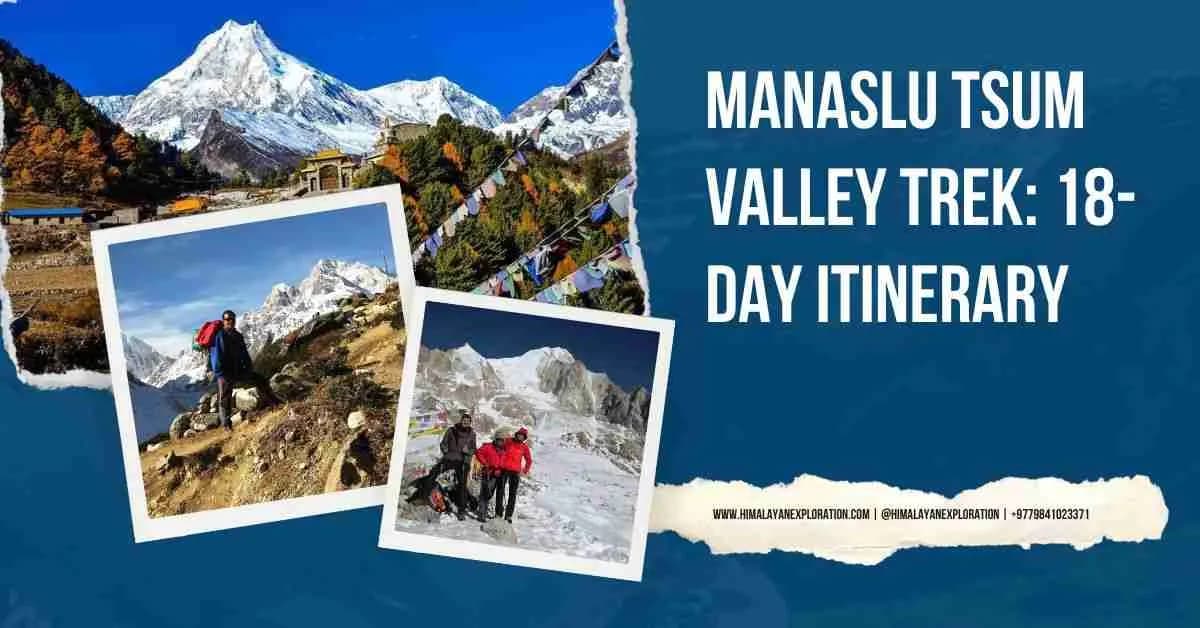
The Manaslu Tsum Valley Trek is an excellent blend of nature and culture in one of Nepal’s most stunning regions. You will see stunning mountains and challenging trails, and learn about local culture. The trek starts from Machha Khola and follows the Budhi Gandaki River through tropical forests to alpine meadows. As you trek in
Gear up for the ultimate adventure as we undertake on a thrilling journey to conquer the majestic Himalayas. In this article, we will take you on an exhilarating expedition across the legendary Larkya La Pass, a high mountain pass connecting the Annapurna Region and the Manaslu Region in Nepal. With its breathtaking views and challenging